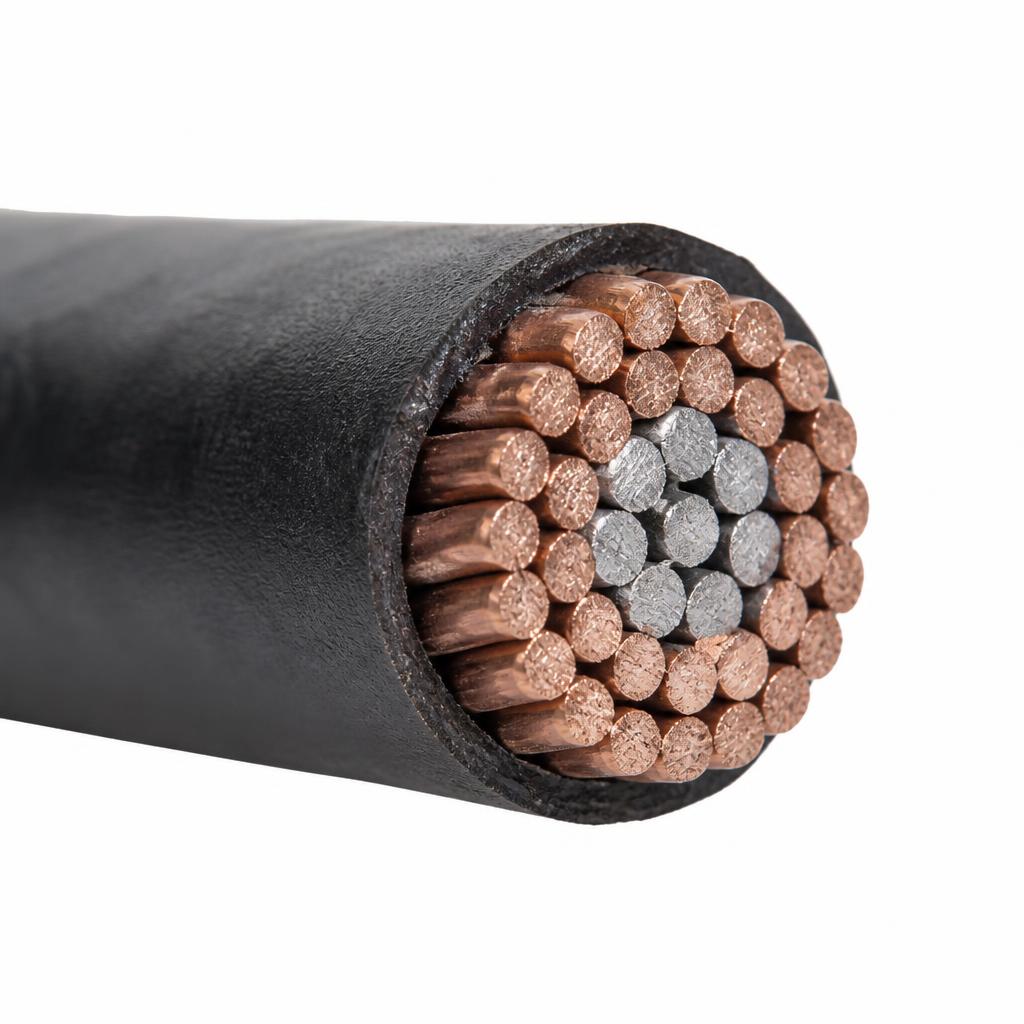
Stranded CCS Cable
7 · 19 · 37 strand · Bunch & concentric lay · S or Z
Why This Conductor
7, 19, or 37 strands. Your move.
7-strand for static runs where you just need a little give during install. 19-strand for dynamic cable tracks — the sweet spot between flexibility and cost. 37-strand for high-flex environments where the cable bends 20 times a minute, 24 hours a day. Concentric lay for controlled impedance. Bunch strand when you need it cheap and round.
3× the flex life of solid copper. 40% lighter.
Steel core, copper skin — the fatigue physics works in your favor. Steel's endurance limit sits way above copper's. So when your flex cable sees 2 million cycles, the copper carries signal and the steel carries the bending stress. Solid copper at equivalent gauge would have work-hardened and cracked six months ago.
Lay length. Direction. Pre-forming. All yours.
S-lay or Z-lay — depends which side of the equator your factory sits on, apparently. We do both. Standard lay lengths run 8× to 25× strand diameter. Need something tighter? Send the drawing. Our bunching machines can hit 4× if the strand count allows it.
Technical Data
| Parameter | Value |
|---|---|
| Strand count | 7, 19, 37 strand (standard) |
| Overall diameter | 0.30 – 12.00 mm |
| Lay direction | S-lay or Z-lay |
| Lay length | 4× – 25× strand diameter |
| Conductivity | 21–55% IACS (per CCS strand spec) |
| Tensile strength | 500 – 1300 MPa |
Frequently Asked Questions
Which strand count should I use for a cable-track application?
19-strand is the sweet spot for dynamic cable tracks, balancing flex life against cost; 37-strand suits high-flex duty where the cable bends 20 times a minute; 7-strand is for static runs. Steel-core CCS delivers roughly 3× the flex life of solid copper at equivalent gauge.
What lay lengths and lay directions can you produce?
Standard lay lengths run 4× to 25× strand diameter in either S-lay or Z-lay, with lay-length repetition held within 0.5 mm across a 900 m length on 37-strand concentric builds. Send the drawing if you need tighter geometry — bunching can reach 4× where strand count allows.
Is stranded CCS cable supplied with its own test certificate?
Yes — stranding is done in-house on the same mill QA system, so each reel ships with a single-source cert pack covering the CCS single-end spec, strand geometry and break-load results. Concentric-lay builds follow ASTM B229.
What tensile strength does stranded CCS provide?
Stranded constructions deliver 500–1300 MPa depending on grade and strand count, with overall diameters from 0.30 to 12.00 mm. That tensile reserve is why CCS messenger and guy strand holds span sag specs where solid copper cannot.
Related Applications & Resources
Custom specification?
We regularly produce bespoke IACS grades, custom coatings and non-standard diameters. Tell us your application — talk to an engineer.